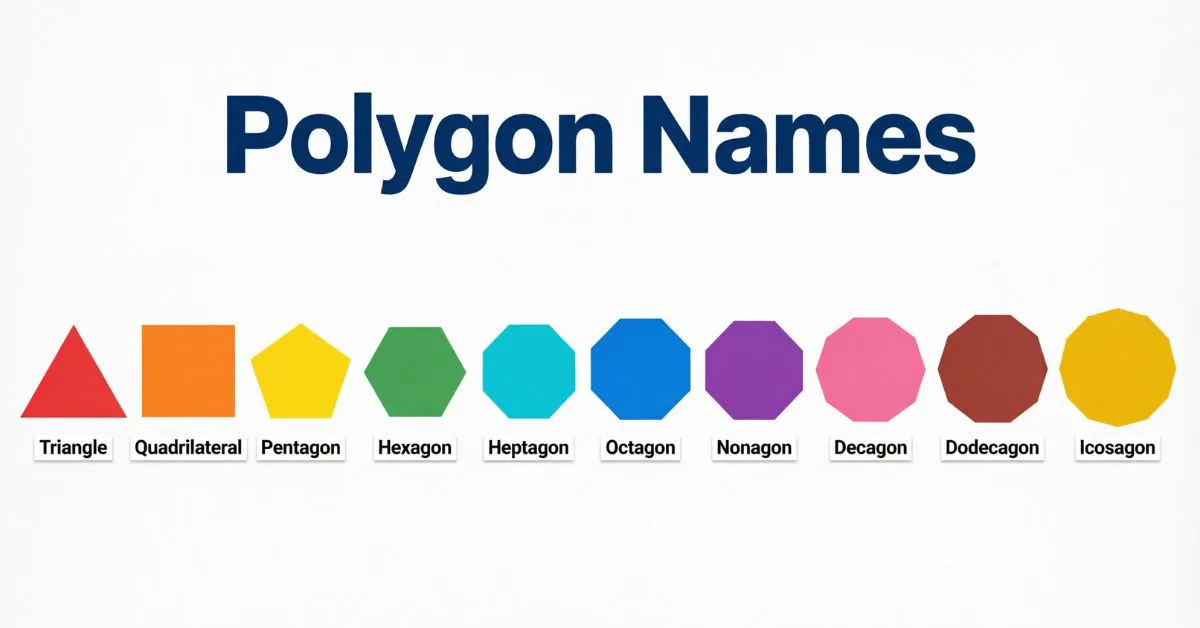
Polygon Names help us identify and understand the many shapes used in mathematics, geometry, architecture, engineering, and everyday life.
From simple shapes like triangles and squares to complex polygons with many sides, each polygon has a unique name based on its number of sides and special properties.
Learning these names makes it easier to recognize shapes and understand how they are used in the world around us.
In this guide, you’ll discover 100+ different types of polygon names with meanings.
Each polygon name is explained in simple language, making this collection perfect for students, teachers, parents, and anyone interested in geometry.
IF you’re studying for school, improving your math skills, or simply curious about geometric shapes, this list will help you learn polygon names quickly and easily.
🔺 Basic Polygon Names
Basic polygon names are the most common shapes taught in geometry. These polygons are named according to the number of sides they have. Once you learn these names, it becomes much easier to identify more advanced polygons.
- Triangle
Meaning: A polygon with 3 sides and 3 angles. It is the simplest polygon. - Quadrilateral
Meaning: A polygon with 4 sides and 4 angles. Squares and rectangles belong to this family. - Pentagon
Meaning: A polygon with 5 straight sides and 5 angles. - Hexagon
Meaning: A polygon with 6 sides. Honeycombs are made of hexagons. - Heptagon
Meaning: A polygon with 7 sides. - Octagon
Meaning: A polygon with 8 sides. Stop signs are octagons. - Nonagon
Meaning: A polygon with 9 sides. - Decagon
Meaning: A polygon with 10 sides. - Hendecagon
Meaning: A polygon with 11 sides. It is also called an undecagon. - Dodecagon
Meaning: A polygon with 12 sides.
📐 Polygon Names Based on Number of Sides
As the number of sides increases, polygons receive new names. These names are often derived from Greek and Latin words. Learning them helps you identify many geometric shapes with confidence.
- Tridecagon
Meaning: A polygon with 13 sides. - Tetradecagon
Meaning: A polygon with 14 sides. - Pentadecagon
Meaning: A polygon with 15 sides. - Hexadecagon
Meaning: A polygon with 16 sides. - Heptadecagon
Meaning: A polygon with 17 sides. - Octadecagon
Meaning: A polygon with 18 sides. - Enneadecagon
Meaning: A polygon with 19 sides. - Icosagon
Meaning: A polygon with 20 sides. - Triacontagon
Meaning: A polygon with 30 sides. - Hectogon
Meaning: A polygon with 100 sides.
⭐ Regular Polygon Names
- Regular Triangle (Equilateral Triangle)
Meaning: A triangle with three equal sides and three equal angles. - Regular Quadrilateral (Square)
Meaning: A four-sided polygon with equal sides and four right angles. - Regular Pentagon
Meaning: A five-sided polygon with equal sides and equal angles. - Regular Hexagon
Meaning: A six-sided polygon where all sides and angles are equal. - Regular Heptagon
Meaning: A seven-sided polygon with equal sides. - Regular Octagon
Meaning: An eight-sided polygon with identical sides and angles. - Regular Nonagon
Meaning: A nine-sided polygon with equal measurements. - Regular Decagon
Meaning: A ten-sided polygon with perfect symmetry. - Regular Dodecagon
Meaning: A twelve-sided polygon with equal sides and angles. - Regular Icosagon
Meaning: A twenty-sided polygon where every side is the same length.
🔷 Irregular Polygon Names
Irregular polygons do not have equal sides or equal angles. They are very common in real life because many natural and man-made shapes are not perfectly symmetrical.
- Irregular Triangle
Meaning: A triangle with sides or angles that are not all equal. - Irregular Quadrilateral
Meaning: A four-sided polygon with different side lengths or angles. - Irregular Pentagon
Meaning: A five-sided polygon with unequal sides. - Irregular Hexagon
Meaning: A six-sided polygon without equal measurements. - Irregular Heptagon
Meaning: A seven-sided polygon with different side lengths. - Irregular Octagon
Meaning: An eight-sided polygon with unequal angles. - Irregular Nonagon
Meaning: A nine-sided polygon lacking symmetry. - Irregular Decagon
Meaning: A ten-sided polygon with unequal sides or angles. - Irregular Dodecagon
Meaning: A twelve-sided polygon with different measurements. - Irregular Icosagon
Meaning: A twenty-sided polygon that is not perfectly symmetrical.
🟢 Convex Polygon Name
- Convex Triangle
Meaning: A three-sided polygon where every angle is less than 180°. - Convex Quadrilateral
Meaning: A four-sided polygon with all interior angles pointing outward. - Convex Pentagon
Meaning: A five-sided polygon with no inward angles. - Convex Hexagon
Meaning: A six-sided polygon where every diagonal stays inside the shape. - Convex Heptagon
Meaning: A seven-sided polygon with all vertices facing outward. - Convex Octagon
Meaning: An eight-sided polygon without any inward corners. - Convex Nonagon
Meaning: A nine-sided polygon with interior angles below 180°. - Convex Decagon
Meaning: A ten-sided polygon that curves only outward. - Convex Dodecagon
Meaning: A twelve-sided polygon with no indentations. - Convex Icosagon
Meaning: A twenty-sided polygon where every interior angle points outward.
🔻 Concave Polygon Names
- Concave Triangle
Meaning: A true triangle cannot be concave because all triangles are always convex. - Concave Quadrilateral
Meaning: A four-sided polygon with one inward angle greater than 180°. - Concave Pentagon
Meaning: A five-sided polygon containing an inward corner. - Concave Hexagon
Meaning: A six-sided polygon with at least one reflex angle. - Concave Heptagon
Meaning: A seven-sided polygon with an inward bend. - Concave Octagon
Meaning: An eight-sided polygon with one or more inward angles. - Concave Nonagon
Meaning: A nine-sided polygon that is not completely outward. - Concave Decagon
Meaning: A ten-sided polygon with one or more interior angles greater than 180°. - Concave Dodecagon
Meaning: A twelve-sided polygon containing inward corners. - Concave Icosagon
Meaning: A twenty-sided polygon with at least one inward angle.
📚 Special Polygon Names
Some polygons have special names because of their unique properties or because they are commonly studied in geometry. These shapes are important in mathematics and everyday learning.
- Equilateral Triangle
Meaning: A triangle with three equal sides and three equal angles. - Isosceles Triangle
Meaning: A triangle with two equal sides. - Scalene Triangle
Meaning: A triangle where all three sides are different lengths. - Square
Meaning: A regular quadrilateral with four equal sides and four right angles. - Rectangle
Meaning: A quadrilateral with four right angles and opposite sides equal. - Rhombus
Meaning: A four-sided polygon where all sides are equal. - Parallelogram
Meaning: A quadrilateral with opposite sides parallel and equal. - Trapezoid
Meaning: A quadrilateral with one pair of parallel sides. - Kite
Meaning: A quadrilateral with two pairs of equal adjacent sides. - Regular Star Polygon
Meaning: A star-shaped polygon formed by connecting non-adjacent vertices.
🏠 Polygon Names in Real Life
Polygons are not just found in textbooks. They appear in buildings, road signs, sports equipment, art, and everyday objects. Learning these examples makes geometry easier to understand.
- Triangle Roof
Meaning: A roof designed in the shape of a triangle for strength. - Square Floor Tile
Meaning: A floor tile with four equal sides. - Rectangular Door
Meaning: A door shaped like a rectangle. - Pentagon Building Design
Meaning: A building with a five-sided layout. - Hexagon Honeycomb
Meaning: Honeybees build honeycombs using hexagonal cells. - Octagon Stop Sign
Meaning: Traffic stop signs are shaped like octagons. - Diamond Window (Rhombus)
Meaning: Decorative windows often use rhombus shapes. - Trapezoid Table Top
Meaning: A table designed with a trapezoid surface. - Kite Toy Shape
Meaning: Traditional kites commonly use a kite-shaped polygon. - Star Decoration
Meaning: Holiday decorations often feature star polygons.
🎯 Famous Polygon Examples
- The Pentagon
Meaning: A famous five-sided government building in the United States. - Soccer Ball Panels
Meaning: Soccer balls use pentagons and hexagons in their design. - Honeycomb Cells
Meaning: Bees naturally create perfect hexagons. - Stop Sign
Meaning: An octagon used for traffic safety worldwide. - Chessboard Squares
Meaning: Every chessboard is made of square polygons. - Window Panes
Meaning: Many windows are rectangles or squares. - Floor Tiles
Meaning: Homes often use square or hexagonal tiles. - Road Warning Signs
Meaning: Many traffic signs use polygon shapes. - Architecture Patterns
Meaning: Modern buildings often include triangles, hexagons, and other polygons. - Company Logos
Meaning: Many brands use polygon designs to create modern and memorable logos.
❓ Frequently Asked Questions (FAQ) About Polygon Names
1. What is a polygon?
A polygon is a closed two-dimensional shape made of three or more straight sides connected end to end.
2. How are polygon names decided?
Polygon names are based on the number of sides they have. For example, a shape with five sides is called a pentagon, while a shape with six sides is called a hexagon.
3. What is the smallest polygon?
The smallest polygon is a triangle, which has three sides and three angles.
4. Which polygon has 10 sides?
A polygon with 10 sides is called a decagon.
5. What is a 12-sided polygon called?
A 12-sided polygon is known as a dodecagon.
6. What is the difference between a regular and an irregular polygon?
A regular polygon has all sides and angles equal. An irregular polygon has sides or angles that are not all equal.
7. What is the difference between a convex and a concave polygon?
A convex polygon has all interior angles less than 180°. A concave polygon has at least one interior angle greater than 180°.
8. Is a circle a polygon?
No. A circle is not a polygon because it has a curved edge instead of straight sides.
9. Where are polygons used in everyday life?
Polygons are found in buildings, road signs, floor tiles, sports equipment, logos, artwork, computer graphics, and many other everyday objects.
10. Why is it important to learn polygon names?
Learning polygon names helps students understand geometry, improves mathematical skills, and makes it easier to identify different shapes in real life.
Conclusion:
Polygon names are an essential part of geometry and help us identify shapes based on the number of their sides and angles.
From simple shapes like triangles and quadrilaterals to larger polygons like dodecagons and icosagons, each polygon has its own unique name and properties.
Understanding the difference between regular, irregular, convex, and concave polygons makes learning geometry much easier.
IF you’re a student preparing for exams, a teacher creating lesson plans, or simply someone interested in mathematics, knowing polygon names can improve your understanding of shapes and their real-world uses.
Save this guide for quick reference and use it whenever you need to identify or learn about different types of polygons.

Easton Reid is a creative naming expert and author at namezhubb.com, helping readers discover unique, trendy, and meaningful names for every purpose.